Field notes · Konark
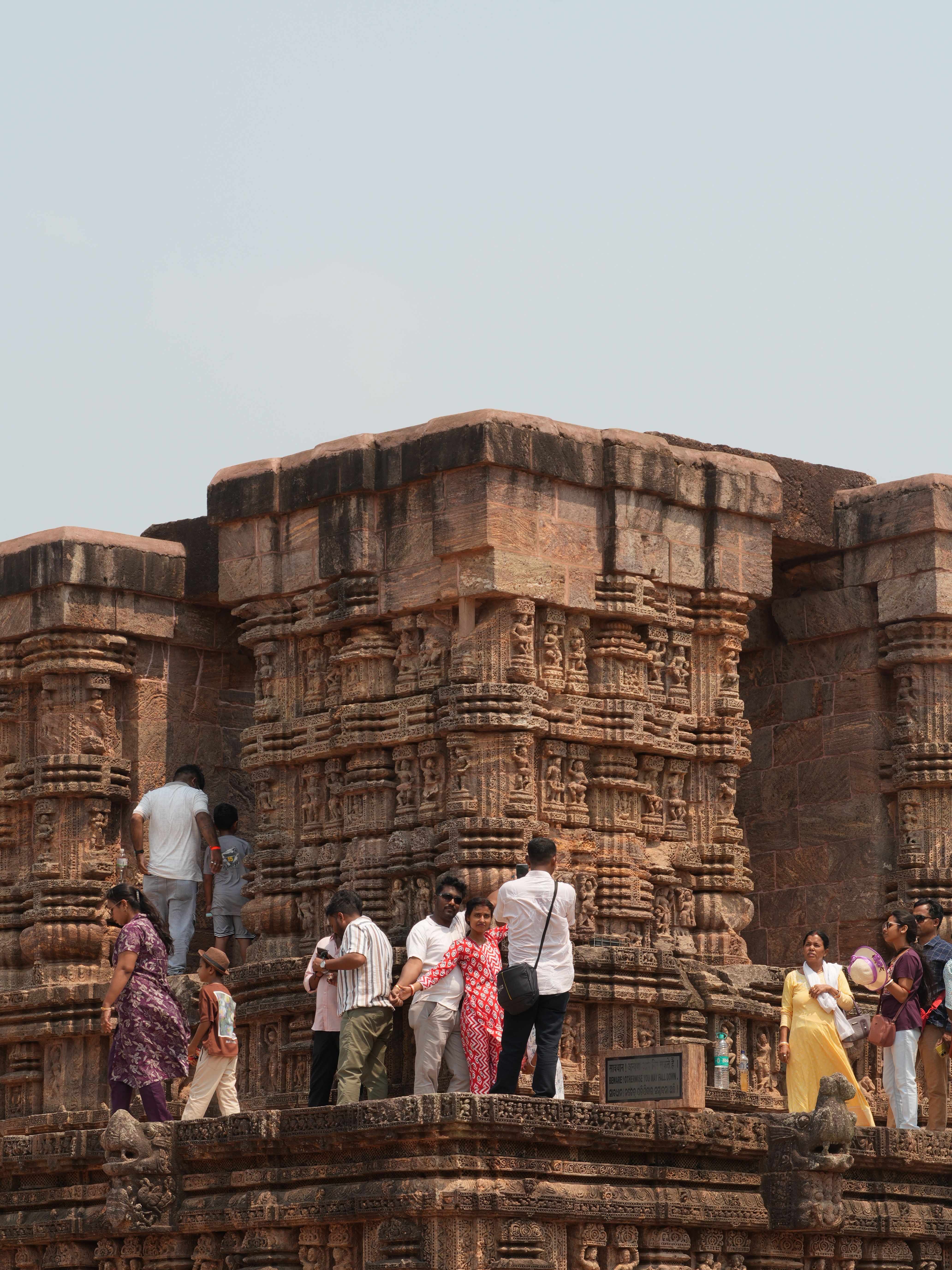
Most visitors arrive at Konark expecting a temple and find, instead, a chariot. The 13th-century Sun Temple was conceived as a colossal stone ratha for the sun god Surya — twelve pairs of wheels, seven straining horses, the whole structure built to look mid-journey across the sky. You don't need to know a line of the history to feel it; the architecture does the explaining before any guide opens their mouth.
But it's the wheels that reward the closest reading. Each of the twelve pairs is nearly ten feet across and carved with such precision that several function as working sundials — the shadow cast by a small pin on the rim tells the time within minutes, even today. We like to stop at just one wheel and spend fifteen unhurried minutes reading it: spokes carved with women at their toilette, warriors, musicians, and small erotic friezes that were, in their era, entirely unremarkable — a plain description of life, not a scandal.
That's the first "paragraph" worth translating: Konark was never meant to be solemn. Odisha's temple sculptors of the Ganga dynasty treated the surface of stone the way a writer treats a page — dense, layered, unafraid of ordinary human detail sitting right beside the divine.
The second paragraph is architectural failure, oddly enough. The temple's main tower collapsed centuries ago, likely from a combination of unstable foundations and salt air off the Bay of Bengal, just a few kilometers away. What remains — the audience hall (jagamohana) and the base of the sanctum — is a fragment of a much taller original. Standing in that gap between what survived and what didn't is, for many of our travelers, more moving than an intact monument would have been.
The third: light. Konark was positioned so that the first rays of sunrise would strike the presiding deity directly. We try to time visits for early morning for exactly this reason — the stone changes colour by the hour, and the carvings that look flat at noon throw deep shadow at 7am, suddenly legible in a way they weren't twenty minutes earlier.
Read slowly enough, and Konark stops being a monument you photograph and becomes a text you're still halfway through translating by the time your guide calls you back to the car.
This story is part of our The Golden Triangle package.